I wanted an AI agent that could answer operational questions and help with a few routine tasks without turning a small home server into a dedicated AI machine. ZeroClaw has been a good fit: it is a Rust agent runtime distributed as a single binary, with providers, channels, tools, and memory behind configurable interfaces.
The appeal is practical. I can keep the agent running on a small ARM device, use a hosted model for reasoning, and add capabilities as separate tools. I do not need to run the language model on that device. This is a description of my deployment, not a benchmark or a claim that every ZeroClaw installation has the same footprint.
The short answer
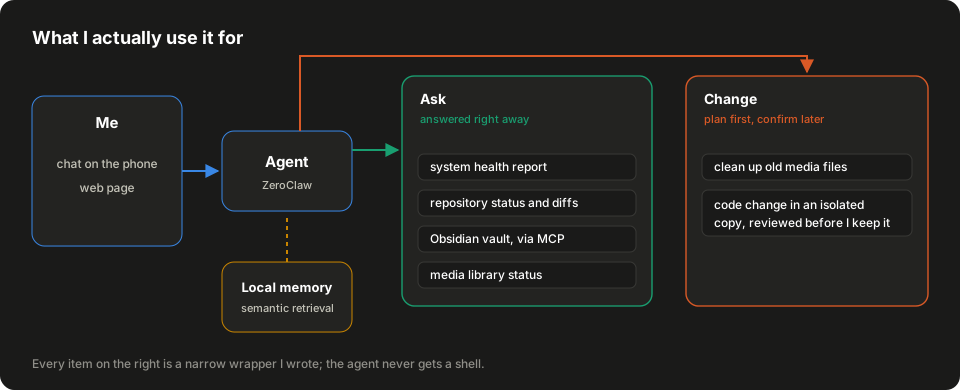
ZeroClaw supplies the agent loop and integrations. I supply a deliberately small set of operations, each with its own input checks and permissions. Read operations can answer immediately. A consequential change first produces a plan for me to inspect, then requires a separate confirmation and a fresh validation before execution.
That division is why the system is useful to me. A light runtime makes it feasible to leave the agent available; explicit tool boundaries make its actions understandable.
What “lightweight” buys me
ZeroClaw’s architecture separates the runtime from model providers, channels, tools, and memory. That lets me choose where each cost belongs. The small server handles orchestration and local I/O; model inference happens elsewhere. I can change providers without rebuilding my operational tools.
I use a user-level service so the agent starts with the machine and recovers after a process failure. A messaging channel makes it available away from my desk. Neither choice requires a large application stack just to keep the agent reachable.
The complete deployment is larger than the ZeroClaw binary. I also run a small local embedding service for semantic memory, alongside SQLite-backed retrieval. That component has its own resource cost and maintenance. Calling the runtime lean is fair; calling the whole system a single-process solution would be misleading.
The agent also reaches my Obsidian vault through the MCP server I built for it. ZeroClaw only grants MCP servers to an agent explicitly, so the vault is one bundle the agent has been given, not something it discovers on its own. That turns my notes, including the documentation of this same setup, into context the agent can search before it answers.
Tools as narrow interfaces
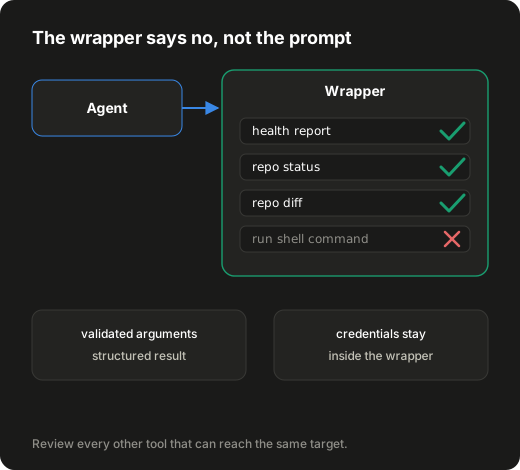
The most valuable work has been deciding what the agent can ask another program to do. I use small wrappers for things like reading system health, inspecting repositories, and managing a media library. Each wrapper accepts a finite command set, validates arguments, and returns structured results. The agent does not need to learn the underlying API or handle its credentials in conversation.
For example, a system-health tool returns a curated report rather than exposing arbitrary process, device, or container commands. A repository tool can inspect status and diffs. A separate code workflow runs proposed changes in an isolated copy and subjects the result to review before I decide what to keep. These are my integrations, not features ZeroClaw automatically provides.
The broader lesson is to put rules in executable interfaces. A prompt can explain the intended workflow, but the wrapper should reject an invalid target or operation even when the model asks for it confidently. The same review must cover every other tool that might reach the target; a narrow wrapper alone cannot enforce a boundary if another route remains open.
A change needs a second turn
For consequential operations, I use a plan-and-confirm flow. The first request resolves the target and shows the exact proposed action. The plan expires and is usable once. A later, unambiguous confirmation refers to that plan; the wrapper rechecks the target and relevant state before it acts. If something changed, it stops and asks for a new plan.
A typical case is asking it to clean up old files in a media library, for example “delete the episodes of this season before episode six”. The agent:
- finds the candidates and gives each one a short-lived id;
- answers with a plan: the exact list of files, how many, and the total size;
- stops there and asks for confirmation;
- when a later message confirms that plan, checks that none of the files changed, and only then deletes them.
The wrapper only works inside a few allowed folders and only on media files. It rejects symlinks and paths outside those folders, and it never deletes directories. The deletion is permanent on purpose, which is exactly why it needs a verified second step.
In simplified form, the write path is:
plan = load_plan(confirmed_id)
reject_if_expired_or_used(plan)
reject_if_changed(inspect(plan.target), plan.expected_state)
consume(plan)
execute(plan.action, plan.target)
The plan identifier binds the second message to a specific action and target. Consuming it before execution prevents a retry from silently applying the same approval twice; a failed execution needs a fresh plan.
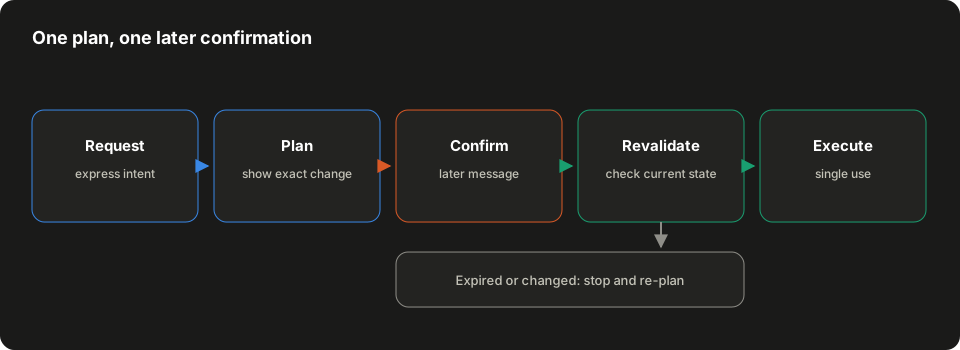
This is more than asking the model to say “Are you sure?” The confirmation gate and state checks live outside the model. It is a useful pattern whenever an agent can affect files, services, or remote systems: show the intended change, bind approval to that change, and refuse to execute stale intent.
The limits I keep in mind
Small runtime requirements do not make an agent cheap in every sense. The model still consumes compute somewhere, and extra memory or integrations add processes and failure modes. Nor does writing a wrapper make a general shell capability safe by itself. The effective security boundary is the complete set of tools, credentials, permissions, and alternate paths the agent has.
ZeroClaw gives me a flexible foundation and runtime security controls. I still have to scope tools, protect secrets, review write paths, and test rejected operations. That is the trade-off I accept for a useful agent on modest hardware: less machinery at the centre, more deliberate engineering at the edges.
Conclusion
ZeroClaw works well for my use case because its runtime stays out of the way. The part worth copying is the architecture around it: separate orchestration from inference, expose narrow operations, keep context local where useful, and require a verified second step before consequential changes. That is how a small agent becomes an operational tool I can reason about.